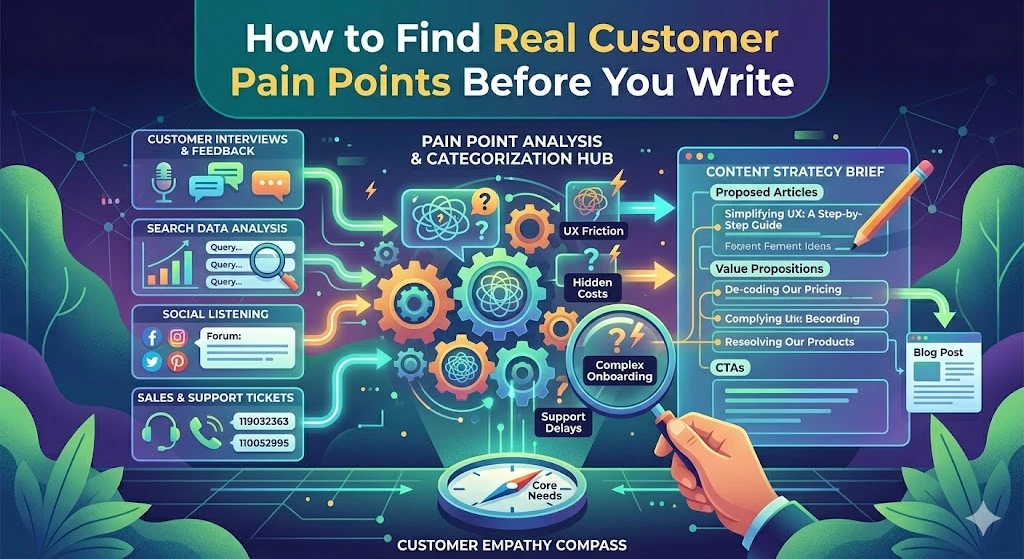
How to Find Real Customer Pain Points Before You Write
By Maks · June 7, 2026
Most marketing content fails for the same reason: it's written from inside the company looking out. Someone in a strategy meeting decides what buyers "probably care about", a brief gets written, a draft gets approved, and the finished post lands somewhere between generic and forgettable. The fix isn't a better template or a smarter AI prompt. It's doing the research before the writing - and doing it on conversations buyers are already having in public.
Here's a practical way to find real customer pain points before you write a single line.
Start with where buyers actually talk
There are three places where buyer language lives in the wild:
Public conversations - Reddit threads, forum posts, YouTube comments, review sites, and Q&A platforms where people describe problems in their own words because they're trying to get help, not impress anyone.
Private touchpoints you already own - sales call recordings, support tickets, churn surveys, cancellation reasons, onboarding chats, and feature requests.
Search behavior - the long-tail questions people type when they're stuck.
Most teams jump straight to keyword tools. Keywords tell you what people search for. They don't tell you why they care, what they've already tried, or what they'd say to a friend about it. For that, you need the messy middle of actual comment threads and call transcripts.
Read for patterns, not topics
The mistake is to read a thread and pull out the topic ("oh, they care about onboarding"). The signal you want is the wording and the trigger.
When you read a thread or a support log, look for:
Exact phrases that repeat. If five different people describe the same problem with similar language ("I keep losing track of which leads replied"), that phrase is gold. It belongs in your headline, not a paraphrase of it.
The trigger event. What happened right before they went looking for a solution? A failed launch, a churned customer, a quarterly review, a competitor's announcement? The trigger tells you when your messaging needs to reach them.
What they already tried. Every "I tried X but it didn't work because…" is an objection you'll eventually have to answer.
The emotional intensity. Frustration, fear, embarrassment, and urgency are stronger buying signals than mild curiosity. Rank pains by how charged the language is, not by how often the topic appears.
This is the difference between knowing buyers care about "lead management" and knowing they're furious that they can't tell which leads they've already followed up with twice. One is a topic. The other is a pain point.
Build a simple pain-point log
You don't need a complicated system. A spreadsheet works. For each pain point you find, log:
The exact wording the buyer used (copy-paste, don't summarize).
The source (thread link, call timestamp, ticket ID).
The trigger that pushed them to look for a fix.
The customer or segment it came from.
The expected impact if you solved it - revenue, retention, time saved, anxiety reduced.
Doing this for even 20–30 entries usually surfaces three or four themes that dominate. Those themes are what your content should address - in the order of how urgent and emotionally intense they are, not how easy they are to write about.
Cross-check against your own data
Public conversations show you the market. Your own data shows you your market - the people who actually buy from you or churn from you.
Pull your last 10 churn surveys and your last 10 onboarding conversations. Tag each piece of feedback by customer, problem theme, and the metric it probably affects. You'll usually find one of two things:
The pains you're seeing in public match what your existing customers say. Good - you have conviction.
They diverge. That's useful too. It usually means the public pain is what gets people interested, while the private pain is what makes them stay or leave. You want content that addresses both.
This is also where the feedback loop matters. When you ship something to address a pain, log whether it actually solved the problem for the person who raised it. A short check-in a few weeks after onboarding ("did this fix the thing you mentioned?") closes the loop between what buyers said they wanted and what actually worked.
Write using the words you found
Once you have a log of real pain points, real wording, and real triggers, the writing gets easier - not because you have a template, but because you've stopped guessing.
Practical rules for using buyer language in content:
Use their phrasing in headlines and subheads. If buyers say "leads going cold", don't write "improve lead nurture velocity".
Open with the trigger, not the solution. Describe the moment the reader recognizes the problem before you describe how to fix it.
Name the objections out loud. If buyers keep saying "I tried a CRM and it was too heavy", address that in the post. Don't pretend the objection doesn't exist.
Match the channel. The same pain point should read differently in a long-form article versus a Reddit comment versus a LinkedIn post. The underlying insight is the same; the register and structure aren't.
Where this gets hard, and how we approach it at Achiv
Doing this research manually works. It's also slow. Reading Reddit threads for an hour can give you one or two strong insights; reading them for a week gives you a real map. Most founders and small content teams don't have a week.
We built Achiv because we kept running into this ourselves. The tool pulls from Reddit discussions tied to your product, surfaces the pains and objections and exact wording buyers are using, and helps turn that research into drafts that match the channel you're writing for. It doesn't replace reading the threads - you'll still want to do that for the high-signal ones - but it makes the pattern-finding step faster, and it keeps the buyer's language attached to the draft instead of getting lost in translation.
The point isn't the tool, though. The point is the order of operations: research first, write second. Whether you do it manually or with help, the teams whose content actually connects are the ones who refuse to start writing until they know - in the buyer's own words - what the buyer is actually trying to solve.
A quick checklist before you draft
Before you open a blank doc, you should be able to answer:
What is the exact pain point, in the buyer's own words?
What triggered them to look for a solution right now?
What have they already tried, and why didn't it work?
Which segment feels this most urgently?
What would they need to see to believe you can help?
If you can't answer those five, you're not ready to write yet. You're ready to do more research. That's not a delay - it's the part that decides whether anyone reads what you publish.