Why GEO/AEO Still Depends on Classic SEO and Intent Matching
By Maks · June 7, 2026
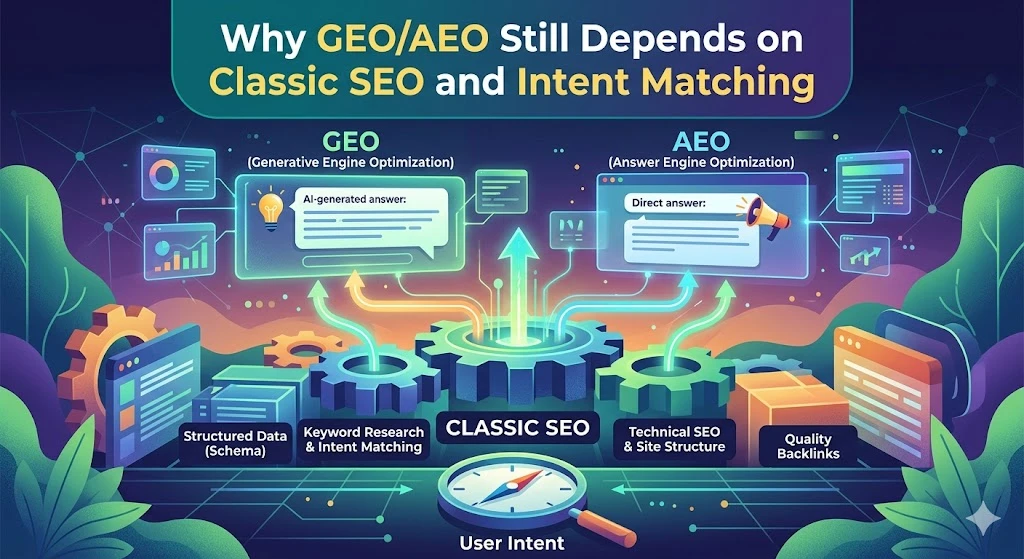
Most of the panic around GEO and AEO assumes the rules of search have been rewritten. They haven't. The retrieval layer underneath ChatGPT, Claude, Perplexity, Grok, and Google's AI Overviews is still a search engine, and that search engine still rewards the same fundamentals: fast pages, clean markup, authority, and content that actually matches the intent behind a query. What changed is the reranking step on top - and that step punishes pages built around keywords instead of around what the buyer is really trying to do.
This article is for people building content and landing pages who keep hearing "GEO is the new SEO" and want a practical breakdown of what to actually optimize, based on how RAG works under the hood.
Classic SEO is not optional - it's the entry ticket
Before anything else: page speed, SSR, structured data (JSON-LD), crawlability, internal linking, and authority signals are still required. Not "nice to have". Required. The reason is simple: every major AI answer engine, when it doesn't already know the answer, runs a search query and pulls a regular SERP. If your page can't be crawled, rendered, or indexed properly, you don't enter the candidate pool. Nothing else matters after that.
So the first mistake to avoid is treating GEO as a replacement for SEO. It's a layer on top.
How AI answer engines actually pick sources
The mechanism most providers follow is some variation of RAG - Retrieval Augmented Generation. Simplified:
The LLM turns the user prompt into one or more search queries (or the prompt already is one).
It retrieves a SERP - usually keyword-driven candidates.
It reranks those candidates with an LLM, scoring by semantic match to the user's actual intent.
It generates an answer, citing some of the reranked sources.
This is why ranking #1 on Google does not guarantee a citation. The rerank step can pull a result from position 7 over the one at position 1 if it answers the intent more precisely, or if the domain carries a stronger bias in the model's training.
A few things follow from this:
Keyword presence still gates retrieval. If the words aren't on the page, you don't make the top 1000 candidates. Semantic search has not killed keywords.
Intent match decides reranking. Once you're in the pool, the model picks based on which page most directly satisfies the question being asked.
Provider preferences differ. ChatGPT and Grok lean harder on freshness and intent match. Google and Claude still weight authority heavily. Plan content accordingly.
LLMs carry bias from training data. If your domain was well-known before the cutoff, the model already has an opinion of it - sometimes that helps, sometimes it hurts. A Wikipedia result sitting at position 7 will often get picked over a stronger match at position 2 because the model trusts the domain by default.
The classic SEO part that still matters: authority and uniqueness
The retrieval layer is still ranking by the same authority signals it always did. Mentions, links, brand presence, and consistent topical coverage feed into whether your page even makes it into the candidate set the LLM reranks.
There's a related trap here that doesn't get talked about enough: similar content loses to stronger-bias content. Even if your page is a strong semantic match for the intent, the model can prefer a competitor's page because the domain has more authority, the content is fresher, or the model has seen that source cited more often during training. You don't beat that by writing the same article slightly better. You beat it by writing something the others didn't write - a different angle, a real experiment, a comparison they don't have, or a depth they skipped.
This is why "produce more unique content" keeps showing up in practitioner advice. Not unique as in spun. Unique as in: would a rerank pick this page over the obvious incumbents because it covers something the incumbents don't?
Intent matching: the most underrated lever
This is where most teams leak organic traffic, and it's the part that matters more under AI search, not less.
The old SEO flow looked like:
target audience → search phrase (e.g., "black t-shirts")
search phrase → article optimized for that keyword
The intent-aware flow looks like:
target audience → inquiry / job-to-be-done (e.g., "buy black t-shirts that don't fade")
inquiry → a structured response that fully answers it
Both retrieval steps still happen - keywords to get into the candidate pool, semantic match to get reranked. But the page itself has to be built around the intent, not around the keyword. That means:
The page covers the full shape of the question, not just the headline keyword.
It includes the formats the intent demands: comparison tables for comparison intent, step-by-step for how-to intent, use-case lists for "is this right for me" intent, FAQ blocks for adjacent buyer questions.
It connects to purchase motivation through clear CTAs so the educational content turns into product action - including dedicated landing pages for social CTAs or QR codes where it makes sense.
A practical heuristic: when you draft a page, write the top 10–20 questions a real buyer would ask around that intent and make sure the page answers them with the right depth and format. Those answers are what the rerank step is scoring against.
One page or many? Use the SERP to decide
A recurring question when organizing content: do I write one big page covering the topic, or split it into multiple targeted pages?
The cleanest test is the SERP itself:
If the SERPs for two queries are mostly the same URLs, treat them as one topic. One page, deeper coverage, more intent shapes covered.
If the SERPs are clearly different, split them. The search engines (and by extension the AI rerankers pulling from them) are telling you the intents are distinct.
There's a nuance: sometimes you do want two pages on the same topic specifically to chase double rankings. That's a tactical choice, not the default. The default is to organize by distinct intent, not by "one keyword = one page".
For larger sites this becomes a clustering problem - grouping thousands of keywords into intent clusters, mapping the spiderweb of search themes around a topic, and prioritizing the clusters where the money is. Most teams skip this step, publish a page per keyword, and end up with thin, duplicative pages that rank inconsistently because no single page fully owns an intent.
What to actually do
If you take one thing from this, take this: GEO and AEO are not new disciplines. They are classic SEO plus disciplined intent matching, on top of content that is unique enough to survive a rerank against stronger-authority domains.
A workable checklist:
Fix the SEO basics first - speed, SSR, structured data, crawlability, authority.
Map your audience's inquiries, not just their keywords. Group them into intent clusters.
For each cluster, decide one page or many by looking at the actual SERP.
Build each page to fully satisfy the intent - right depth, right formats, FAQ for adjacent questions.
Keep the keyword coverage so you survive the retrieval step.
Add something genuinely unique - an experiment, dataset, comparison, or angle - so you survive the rerank step.
Refresh frequently, especially for queries where ChatGPT, Grok, and Perplexity are the traffic source.
Connect educational pages to product action with clear, specific CTAs.
Where tooling helps
The bottleneck for most small teams isn't writing - it's the intent mapping and clustering work upstream. Figuring out which inquiries to target, which ones share a SERP, which ones deserve their own page, and which clusters have actual buyer pain behind them is the part that takes weeks and usually gets skipped.
This is part of what we've been building Achiv for. The same engine that clusters pain points and objections from real user signal also feeds into a content layer - turning those clusters into article angles grounded in what buyers are actually asking, so the page goes into the world already shaped around an intent instead of around a keyword. It won't fix authority for you, and it won't replace the experimentation part. But it does cut the time from "I have a topic" to "I have an intent-mapped brief I can publish against".
The short version
Classic SEO is the entry ticket. Authority gets you into the candidate pool. Intent matching wins the rerank. Uniqueness keeps you from losing to incumbents the model already trusts. Nothing about that is new - GEO and AEO just raised the cost of getting any of it wrong.