
A 6 Month Long Experiment - How pain-driven SEO content beat AI-generated spam
By Maks · June 1, 2026
Most AI content does not fail because it picks the wrong words. It fails because nothing real is behind the words. The grammar is clean, the structure is fine, the H2s are predictable - and a reader can feel within two sentences that no one actually lived through the problem being described. Google has gotten good at feeling this too. If you are trying to rank in 2025, the gap between "AI-generated filler" and "content that ranks and gets cited" is not better prompts. It is whether the piece is grounded in a specific pain a specific person actually has.
This article is the short version of a six-month experiment I ran to test that. One project got nuked by Google. The next one - same writer, same models, different input - started pulling hundreds of AI citations per week and hundreds of organic users per month, on a near-zero SEO budget. The difference was pain-driven content.
The experiment that got banned: pure AI, no pain
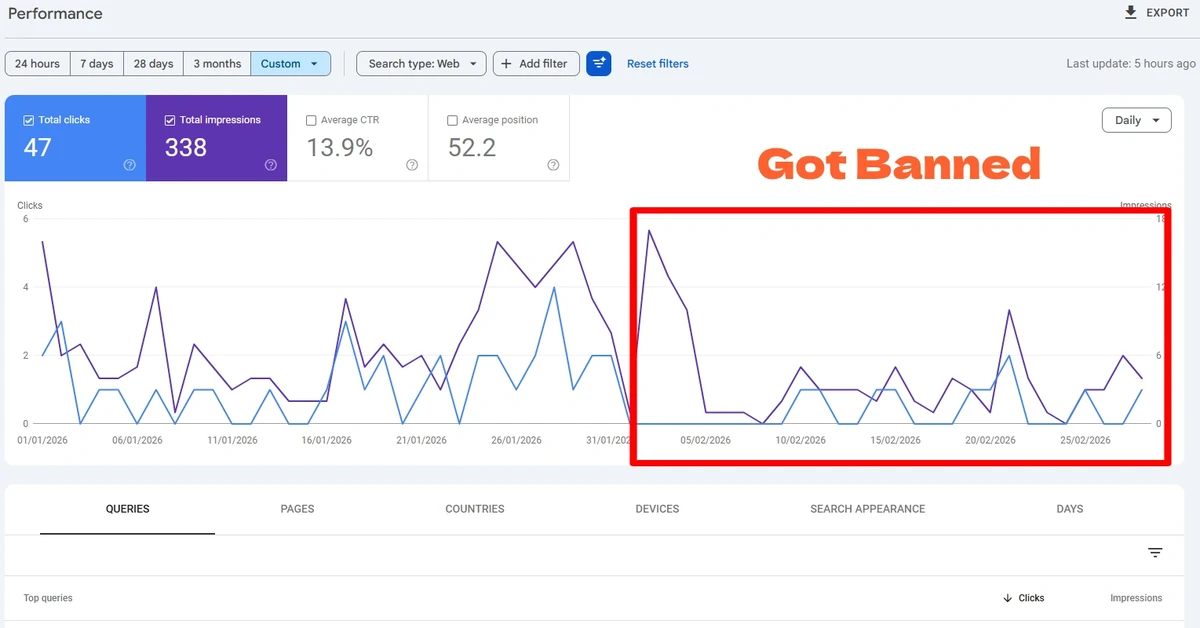
The first project was an AI-generated horoscopes site. Daily, weekly, monthly, and annual horoscopes. Multilingual. Top-tier models. A solid backlink profile. Even some randomization injected so the "predictions" read with a little texture instead of pure template.
On paper, everything was correct. Structured pages, internal linking, multilingual coverage, fresh content every day. In February, Google fully banned the project for low-quality content.
The reason is simple. There was no real-world experience behind a single sentence. Horoscopes are already a soft signal at best, and an AI writing horoscopes is just text generating text. No human had a bad Tuesday and figured out why. No one had a pattern to share. The model was hallucinating mood reports for twelve zodiac signs in eight languages. Google's job is to separate low-effort generation from valuable nuggets, and it did exactly that.
That ban was useful. It killed a hypothesis cleanly.
The next hypothesis: AI grounded in real pain
The second experiment was the opposite setup. Instead of asking the model to invent content from nothing, I fed it three things:
A specific, named pain a specific audience actually has.
Real-world context - what people say about that pain in their own words, where they say it, and what they have already tried.
A data-driven angle so the piece tells a story instead of summarizing a topic.
Same models. Same writing pipeline. Different inputs.
The result was not a viral spike. It was steady: hundreds of AI citations per week, hundreds of organic users per month, with minimum time and budget spent on SEO. No link-building sprints. No content calendar marathons. The content was found, cited, and read because it answered something a real person was actually asking.
That is the whole thesis. AI content fails when it has no pain to ground it. AI content wins when it does.
Why "pain-driven" beats "AI-generated"
Look at it from the buyer's side, not the writer's side. A reader landing from search is not evaluating your grammar. They are running a fast filter:
Does this person understand my exact situation?
Are the examples specific or generic?
Is there a tradeoff, a failure mode, a real number - or just smooth surface?
Would I send this link to a colleague, or close the tab?
Generic AI content fails every one of those filters. Not because the language is wrong, but because the experience is missing. There is no "we tried X for three months and it broke at step 4". There is no "the buyer's first objection is usually Y". There is no contrast between what the founder thinks happens and what actually happens in production.
Google's ranking systems and the LLMs doing AI citations are now optimizing for the same thing: evidence of real authority. Not domain authority in the old backlink sense - authority as in, this content clearly comes from someone who has done the thing. Pain-driven content carries that signal naturally. AI-generated topic summaries do not.
How to actually do pain-driven SEO content
This is not "add a personal anecdote to your blog post". It is a different starting point. Instead of starting with a keyword and asking AI to fill 1,500 words, you start with a pain and work backwards.
A workflow that holds up:
Pick one specific pain, not a topic. Not "Reddit marketing". Something like "my Reddit posts keep getting removed and I do not know why". Narrow it HARD.
Mine real voices on that pain. Read what people actually write about it - the wording, the objections, the failed attempts. Do not paraphrase. Pull the specifics: tools they tried, numbers they mention, what they ruled out.
Find the data angle. What pattern, contrast, or counterintuitive finding can you anchor the piece around? A failed experiment counts. A "we expected X, got Y" counts.
Write the thesis first, in one blunt sentence. If you cannot state the point of the article in one sentence without hedging, the piece is not ready.
Use AI to draft, not to think. Give the model the pain, the voices, the angle, the thesis, and your raw notes. Let it structure prose. Do not let it invent the substance.
Cut anything that could appear in a generic article on the same topic. If the sentence works on any blog, it is filler. Replace with something only you would write.
This is slower than spinning 30 AI articles a week. It is also the only version that survives long-term, because each piece has a reason to exist.
Where Achiv fits in
This experiment is the reason Achiv exists in its current shape.
The painful part of pain-driven content is not writing it. It is steps 1 and 2 - finding the specific pain worth writing about, in the audience's real words, with enough texture to actually ground the piece. Most founders skip this because it takes weeks of manual reading.
Achiv runs that research for you. You throw in your product URL, and it pulls real conversations from Reddit where your audience is venting about the problems your product solves. It clusters those into named pains and objections, with the strength of each signal, so you can see which pain is worth writing 2,000 words about and which one is noise. Then you hand it your raw thoughts - a failed experiment, a counterintuitive result, a workflow you built - and it frames them into an SEO article that is grounded in the pain instead of floating above it. One click, and the same thinking is reshaped into a Reddit post that fits the subreddit it is going into.
That is the loop: real pain in, grounded content out, for SEO and for Reddit. Not automation for the sake of volume. Automation of the research step that nobody wants to do manually, so the writing step actually has something to stand on.
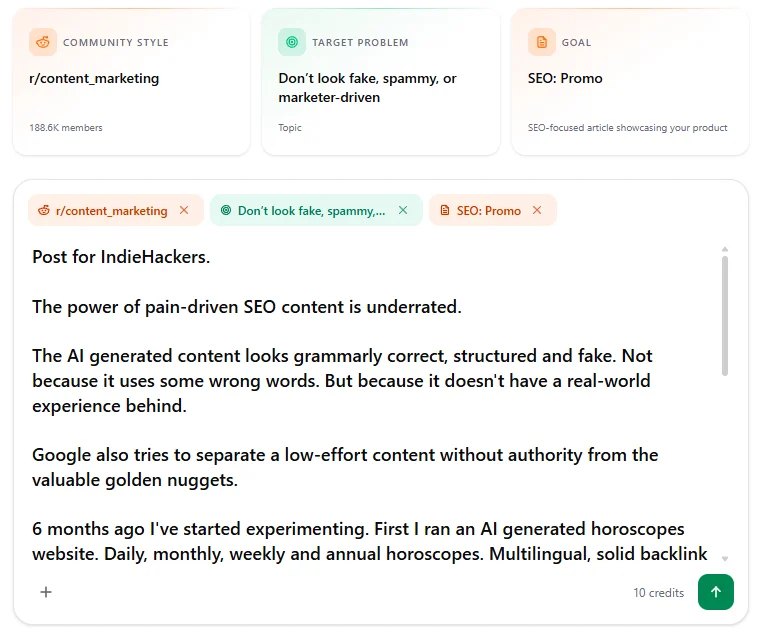
Yes, Achiv created this post out of real pain automatically selected from the list of pains identified during research to properly frame author's raw thoughts.